
Where NJDOC Releases Go
No adult NJDOC prison is identified within Monmouth County. A Monmouth Superior Court sentence can still commit a person to the statewide system, and the person may be housed elsewhere in New Jersey. A move from MCCI to NJDOC is a transfer into state custody. It is not a county-jail community release.
Later exit from NJDOC can lead to parole or full discharge, depending on the record and sentence. Parole ends physical prison custody but places the person under New Jersey State Parole Board supervision. A Date Out-of-Custody confirms the endpoint shown for NJDOC custody. It does not by itself establish completion of parole, identify a home address, or clear every possible hold.
| Status event | Correct interpretation |
|---|---|
| MCCI to NJDOC | Transfer into state prison custody |
| Date Out-of-Custody | Historical exit date from NJDOC custody |
| Current Parole Eligibility Date | Expected eligibility calculation, not completed release |
| Current Max Release Date | Changing calculated maximum date, not an exact gate time |
Confirm an NJDOC Release
The official NJDOC incarcerated-person finder is the principal public route. It concerns people committed to state corrections. A person who only posted bail, left MCCI on conditions, completed a short county term, or had a county case dismissed may never appear.
- Search by SBI number when available. Otherwise use the full name and supported spelling variants.
- Match physical details, aliases, county of commitment, sentence, and case information before opening the record.
- Read incarceration history and Date Out-of-Custody for a completed state exit. Do not rely only on Current Facility.
- Record Current Max Release Date and Current Parole Eligibility Date separately when researching a future event.
- If parole appears likely, contact the State Parole Board Public Information Office. Request an identified NJDOC record through state OPRA when the public view is insufficient.
“Monmouth” under County of Commitment connects the state sentence to the venue where the person was tried, convicted, and sentenced. It does not mean the current state facility is in Monmouth County. The broader Monmouth County release lookup helps when the last custody system is not known.
NJDOC Release Record Contact
The public offender record is the fastest route for state status and defined date fields. When an existing document is needed, use New Jersey OPRA Central and direct the request to NJDOC. Identify the person, SBI number, facility or date range, and the exact record. Useful targets include final discharge paperwork, a release movement entry, the Date Out-of-Custody record, or an identified state offender photograph.
The official NJDOC offender search provides the statewide lookup shown below.
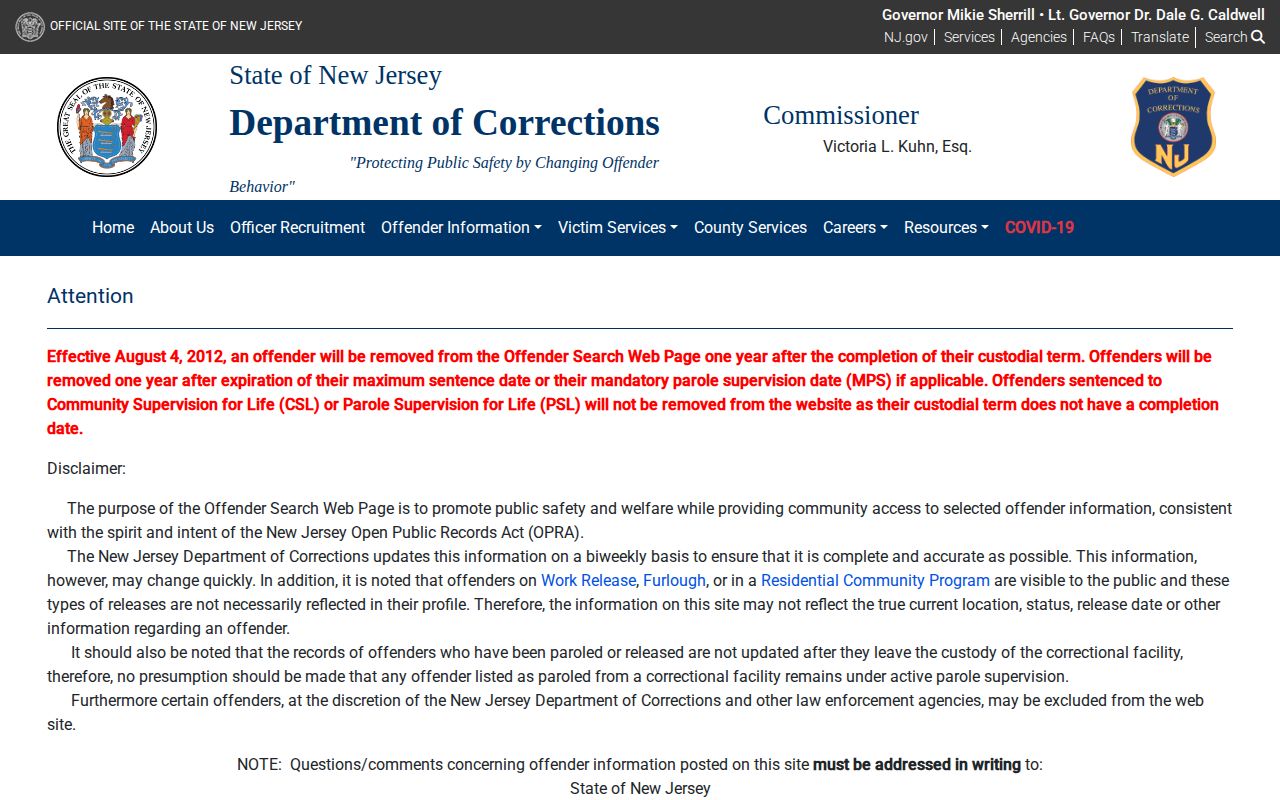
The search image shows the right state-system entry point; county-only MCCI releases remain outside its core scope.
New Jersey Department of CorrectionsPublic offender information and records requests
Use the NJDOC finder and New Jersey OPRA Central New Jersey State Parole Board
P.O. Box 862
Trenton, NJ 08625-0862
609-292-4257
SPB-Public-Info-Office@spb.nj.gov
NJDOC inmate-record rules can limit access to protected material. A request should name an existing document, not demand a new explanation or compilation. Ask for nonexempt portions if part is withheld. Use the Parole Board for public information about a person who has left prison on parole, because the NJDOC date alone does not describe active supervision.
NJDOC Release Search Scope
NJDOC is a statewide prison system, not a single Monmouth County detention facility. Its finder covers people committed to state corrections and can retain historical incarceration information. This makes it materially different from MCCI’s unavailable live search. Yet it is not a statewide list of every arrest or county-jail stay.
A no-result has several possible causes. The event may have stayed at the county level, fallen outside display scope, involved another custody system, used a different identifier, or become restricted through sealing or expungement. Recheck the SBI number and name. Then follow the court and county record if the case never produced a state commitment.
- SBI number
- The state identification number assigned to the offender and the strongest public search key.
- County of commitment
- The venue tied to trial, conviction, and sentence, not the current prison location.
- Discharge
- The end of a stated correctional or supervision jurisdiction, based on the agency’s record.
- Parole
- Release from prison into legal supervision by the State Parole Board.
NJDOC Release Date Fields
NJDOC’s official field definitions prevent three dates from being collapsed into one. Date Out-of-Custody is historical. Current Max Release Date is a changing calculation. Current Parole Eligibility Date concerns eligibility policy and does not promise that a person will physically leave prison then.
| NJDOC field | What it shows |
|---|---|
| Date In-Custody | Date admitted to state custody |
| Date Out-of-Custody | Date released from NJDOC custody |
| Initial Admission Date | Start of the most recent incarceration |
| Current Max Release Date | Latest maximum calculation after time earned or added |
| Current Parole Eligibility Date | Most recent expected eligibility date under Board policy |
| Current Prison Sentence History | Offense, sentence date, term, counts, and commitment data |
The Current Max Release Date may differ at the end of each month because earned days and negative institutional conduct can affect the calculation. The parole eligibility date can also be affected by hearing or administrative review, mandatory terms, new sentences, detainers, or rescission. Neither is an exact release hour.
NJDOC Discharge Paperwork
NJDOC’s Office of Programming and Supportive Services describes a Fair Release and Reentry Act portfolio. It can include final discharge paperwork, temporary identification, property and account material, medical documents, and notice of an active detainer where applicable. Eligible people may also have an opportunity to purchase discounted transit tickets before release.
These materials serve practical release needs, but they are not interchangeable with the public offender finder. A public Date Out-of-Custody can confirm the state custody endpoint. The individual portfolio may hold more detailed documents tied to the person’s own discharge. A focused NJDOC records request should name the desired existing item.
Note: An active detainer notice can explain why the end of NJDOC custody did not result in a community return.
Monmouth NJDOC Commitment Trail
A Monmouth Superior Court judgment supplies the legal reason for a state commitment. It can show the offense, sentence, mandatory term, credits, and other terms. The NJDOC record then supplies state-system custody history and calculated dates. Together they distinguish a transfer out of MCCI from a later state release.
If the public state record shows Date Out-of-Custody, inspect whether parole followed. The Board’s public information office can address releasable person-level parole information. A weekly eligibility notice is only prospective. It identifies people who may be considered or released if approved, not a list of final decisions or completed releases.
NJDOC Release Record Limits
The finder can establish identity within state scope, county and sentence information, state location, calculated dates, and displayed history. It cannot establish an exact prison gate time, a current home address, compliance with parole terms, an assigned officer, or unrestricted sentence completion. Those questions belong to other records and agencies.
A photograph in an NJDOC record belongs to state custody. It must not be described as the MCCI booking photo unless an official source actually connects it to MCCI. Likewise, an NJDOC result does not retroactively convert a county-only jail stay into a state-prison event.
NJDOC Historical Release Proof
A dated state record is stronger than a failed name search. Save the SBI number, County of Commitment, incarceration history, Date Out-of-Custody, and date the page was checked. If the public record changes, those details identify which state incarceration was reviewed and prevent confusion with a different person or an earlier sentence.
When the public entry lacks needed context, request a specific existing record from NJDOC. A final discharge paper can address discharge. A release movement entry can document the state custody endpoint. A Parole Board decision can describe parole action. The Monmouth judgment can establish the sentence that led to commitment. No single document should be stretched beyond its own agency and purpose.
The same rule applies to transfers. An MCCI record may show that county custody ended because NJDOC received the person. The first NJDOC admission and later Date Out-of-Custody then describe the state interval. If another detainer took effect at release, the receiving system must be checked separately. State release, parole, and final discharge remain distinct findings.
VINE can add a near-event custody alert while the person remains within a covered county jail or state correctional facility. It does not replace NJDOC’s historical record. A later VINE no-result can reflect release, transfer, identity mismatch, or timing. Use the dated state history for the lasting NJDOC release evidence.
Note: Keep the retrieval date with any NJDOC result because calculated fields and public displays can change over time.