
Monmouth Projected and Actual Dates
A projected release date is a calculation made before the custody exit. An actual release date records the event after it occurs. In NJDOC terminology, Current Max Release Date is the changing maximum-date estimate. Current Parole Eligibility Date marks when parole consideration may occur under Board policy. Date Out-of-Custody is the historical field that records release from NJDOC custody.
Those dates cannot be substituted for one another. Parole eligibility is not a promise of release. A maximum date can move as credits or negative institutional conduct are posted. Date Out-of-Custody carries more weight after the event, yet it still does not prove that parole or another sentence component has ended.
A Monmouth County pretrial detainee usually has no set projected date because the case, bail status, release conditions, and possible holds remain unresolved. A sentenced person may have a calculable term, but the responsible system must make that calculation.
Find Monmouth Projected Release Dates
The correct route follows the last custody system. NJDOC’s public finder applies to people committed to state corrections, including a person sentenced in Monmouth County but housed elsewhere in New Jersey. It does not cover every person who spent time at MCCI. A county-only sentence requires MCCI computation and court records.
- Identify whether the person is awaiting trial, serving a county term, or committed to NJDOC. Do not assume that disappearance from MCCI means release.
- For state custody, open the NJDOC incarcerated-person finder and search by SBI number when available, or by a carefully matched name.
- Match county of commitment, physical descriptors, sentence history, aliases, and commitment data before reading any date.
- Record Current Max Release Date and Current Parole Eligibility Date separately. Neither is Date Out-of-Custody.
- For an MCCI sentence, obtain the judgment, jail-credit award, MCCI computation or release record, and applicable county credit information.
- Check for another agency’s warrant, detainer, or court order that could block community release.
- Confirm the event afterward through the dated NJDOC history or an MCCI release record.
The general released-person search path, including MCCI, court, and transfer checks, is available on the Monmouth County released inmates home page. A county record and a state record answer different questions.
Note: “Monmouth” as county of commitment links the prosecution to Monmouth County; it does not identify the person’s current facility.
Monmouth NJDOC Release Date Fields
The NJDOC detail contains more than one date because each answers a separate part of the sentence. Its official field definitions should control the reading. Current Facility is a present state-system location. Date In-Custody and Initial Admission Date describe entry points. Incarceration History places custody periods within the most recent incarceration.
| NJDOC field | How to read it |
|---|---|
| Current Max Release Date | Latest calculated maximum release date after days earned and days added; it may change monthly. |
| Current Parole Eligibility Date | Expected eligibility point under Parole Board calculation policy, not a guaranteed exit. |
| Date Out-of-Custody | Historical date released from NJDOC custody. |
| Mandatory Minimum Term | Period before which release is barred, less applicable court-awarded credits. |
| Maximum Term | Total imposed term, subject to lawful court and institutional credits. |
| Current Prison Sentence History | Offense, sentence date, term, counts, and commitment details that explain the calculation. |
The public record cannot establish an exact gate time, present home address, or unrestricted completion of every term. A Date Out-of-Custody may coexist with parole supervision.
The official NJDOC search is shown in the successful manifest image below.
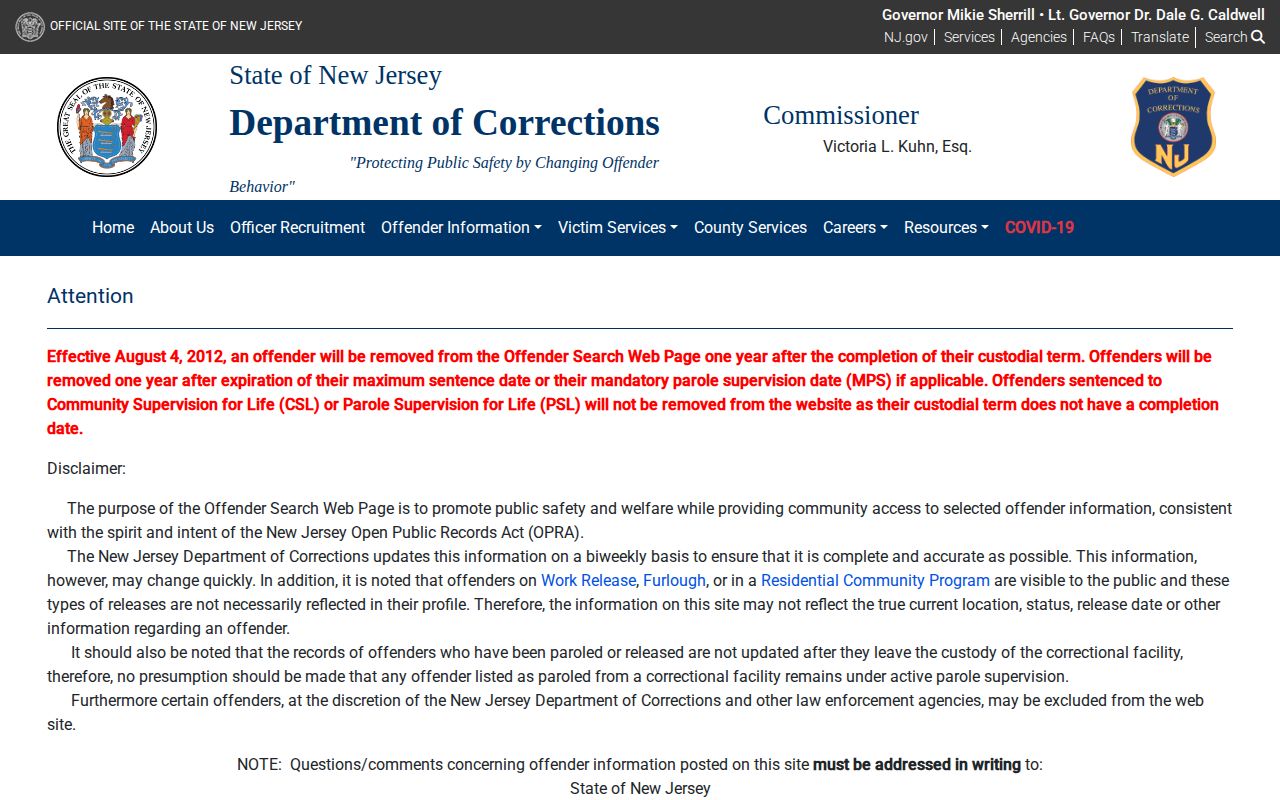
The state finder is appropriate only after confirming that the person entered NJDOC custody, not for a county-only detention.
Monmouth Release Credits and Computation
NJDOC calculates its own dates. The agency accounts for sentence structure, consecutive or concurrent terms, jail credits, mandatory minimums, earned and forfeited credits, new judgments, institutional status, and agency rules. A simple subtraction from the sentence length is unsafe and can produce a false date.
The NJDOC family guide identifies several credit types. Commutation, often called good-time credit, can be granted on prison sentences and forfeited for misconduct. Work credit is one day for each five days served in an assigned work detail or a qualifying vocational or mandatory educational program. Minimum-custody credit is three days per month for the first twelve months and five days per month after that in minimum or community custody.
R.S. 30:4-140 governs commutation credits. R.S. 30:4-92 governs work and minimum-custody remission. N.J.S.A. 30:4-123.51 links credits to parole eligibility and generally places primary eligibility after a mandatory minimum, or after one-third of the sentence less allowable credits if no minimum applies. Credits do not reduce a judicial or statutory mandatory minimum.
Verified county-jail work credit can affect a county sentence, but state commutation rules should not be copied onto all pre-sentence MCCI custody. MCCI publishes no projected-release calculator or public county good-time policy.
Monmouth NERA Release Minimums
New Jersey’s No Early Release Act applies to enumerated first- and second-degree offenses. Under N.J.S.A. 2C:43-7.2, the sentencing court imposes an 85 percent parole-ineligibility minimum for covered crimes. It is not a broad rule for every Monmouth County conviction.
Good-time or work credits cannot erase that mandatory floor. NERA also includes supervision after release, so leaving prison may not equal completion of the sentence. The judgment and NJDOC sentence history are needed to determine whether the statute applies to the particular case. Avoid estimating from the charge name alone.
Note: The 85 percent minimum applies only to covered offenses and must be read from the actual sentence and governing statute.
Monmouth County Sentence Dates
A person serving only a county term at MCCI does not receive an NJDOC Current Max Release Date. Begin with the judgment and jail-credit award. Then ask MCCI for its computation or release record and any applicable county-institution credit information. Counsel or the facility should resolve a disputed calculation.
Pretrial detention is different. There may be a court hearing, bail decision, conditional release, dismissal, plea, sentence, or outside hold before physical departure. None of those events can be converted into a fixed public countdown. A judgment stating time served explains the court’s authority but may not reveal whether a detainer delayed the actual exit.
The MCSO inmate-search page is currently unavailable, so it does not supply a projected date, release window, or past release archive. A focused MCSO OPRA request can seek an existing booking-and-release transaction after the event.
Useful request details include the full name, date of birth if known, MCCI booking number, arresting agency, approximate confinement dates, and court number. Ask for the existing admission and release transaction, jail-credit data, and release disposition. The records custodian may redact protected material, but a precise request is more likely to identify the computation record than a general question about when someone will leave.
Municipal and Superior Court records must also be kept distinct. A municipal disposition may explain a short police or county custody event. An indictable case and state-prison judgment belong in Superior Court and may lead to NJDOC. The judgment explains legal authority, while the jail or DOC history confirms the physical custody event.
Why Monmouth Release Dates Change
A future date is a working result, not a promise. NJDOC says Current Max Release Date can differ at the end of each month. Some factors alter the term calculation. Others leave the custody-system date intact but prevent release into the community.
| Factor | Possible effect | Best confirming source |
|---|---|---|
| Earned credits | May move a calculated maximum date within legal limits | NJDOC record and credit rules |
| Negative institutional conduct | Can add days or cause forfeiture of credits | NJDOC recalculation |
| New or amended judgment | Can change terms, counts, credits, or sentence structure | Court judgment and NJDOC history |
| Mandatory minimum | Bars release before the governing minimum | Judgment and statute |
| Parole action | A grant, denial, or rescission can set, postpone, or cancel a planned parole release | NJSPB final action |
| Detainer or outside warrant | May cause transfer to another agency instead of community release | Holding and receiving agencies |
A detainer is a request or hold from another authority. It can turn an MCCI or NJDOC exit into a transfer. The person may be out of one system while still in custody elsewhere.
Confirm Monmouth Actual Release Dates
Before release, register through the Monmouth County VINELink check when the person is in a participating jail or state facility. An alert can report release or transfer. Because the event comes from an automated facility feed, confirm important timing with the responsible agency.
After an NJDOC release, read Date Out-of-Custody and incarceration history. If parole is involved, use the State Parole Board for releasable supervision information. After an MCCI event, ask whether the disposition was community release or transfer and request the exact release date, time, reason, and receiving agency when needed.
The court judgment supplies the legal basis, but it is not a minute-by-minute door log. The strongest chain combines the sentence or order with the dated custody record. That distinction keeps a Monmouth County projected release date from being mistaken for proof that the person actually left.
For parole, the Board’s eligibility notice can show that a person may be considered during a stated period. It is not a grant or results page. A grant can set a future release date, and later adverse information may produce rescission before the person exits. Confirm a parole outcome with NJSPB public information or an identifiable final record.
Record the retrieval date and exact field label. A later NJDOC recalculation may change the displayed maximum date, while a court amendment can alter the sentence itself. Keeping those sources separate shows why two dated checks can legitimately differ.
Note: Confirm the destination as well as the date because release from one agency can be immediate transfer to another.