
New Jersey Parole Releases
The New Jersey State Parole Board makes release decisions and administers state parole supervision. A person with an NJDOC Date Out-of-Custody can still be under Board jurisdiction. Physical departure from prison and final discharge from the sentence are separate events.
Parole differs from Monmouth probation. Probation is imposed and supervised through New Jersey Courts. It may follow a county-jail term or begin without state-prison custody. NJSPB should not be asked to verify probation, and a Judiciary probation office does not maintain the state parole record.
| Status | Responsible source | What it means |
|---|---|---|
| State parole | NJDOC history and NJSPB | Out of prison under Board supervision |
| Probation | Court judgment and Judiciary | Community sentence supervised by the courts |
| Discharge | Final agency record | End of the stated custody or supervision authority |
| Parole eligibility | NJDOC and NJSPB notice | Possible consideration, not completed release |
Confirm Monmouth Parole Status
Public verification starts with the NJDOC offender record. Match the SBI number, county of commitment, sentence, and identity details. Date Out-of-Custody is the historical state custody endpoint. Current Parole Eligibility Date is a calculation and should not be treated as proof that release occurred.
- Search NJDOC with the SBI number or full name and confirm the Monmouth County commitment and sentence.
- Read Date Out-of-Custody and incarceration history. Separate that historical date from future maximum or eligibility fields.
- Check NJSPB’s offender-search information page, which routes the public back to NJDOC for the offender record.
- Email or call the Board’s Public Information Office for releasable information about a person eligible for parole or under supervision.
- Request a named final decision, release certificate, or other existing Board record through NJSPB OPRA when documentary proof is needed.
No public statewide parolee map exposes assigned officers, home addresses, reporting times, conditions, or compliance. Ask only for information the Board is authorized to release. For a wider custody check, use the Monmouth County released-inmate search.
NJSPB Records and Contact
The Board’s Public Information Office is the person-level contact for parole information. Its OPRA form is the documentary route. Evaluative material, victim information, medical records, security details, and some supervision information can be protected, so a request should name the exact existing record and accept lawful redaction.
The NJSPB offender-search information page supplies the official routing shown below.
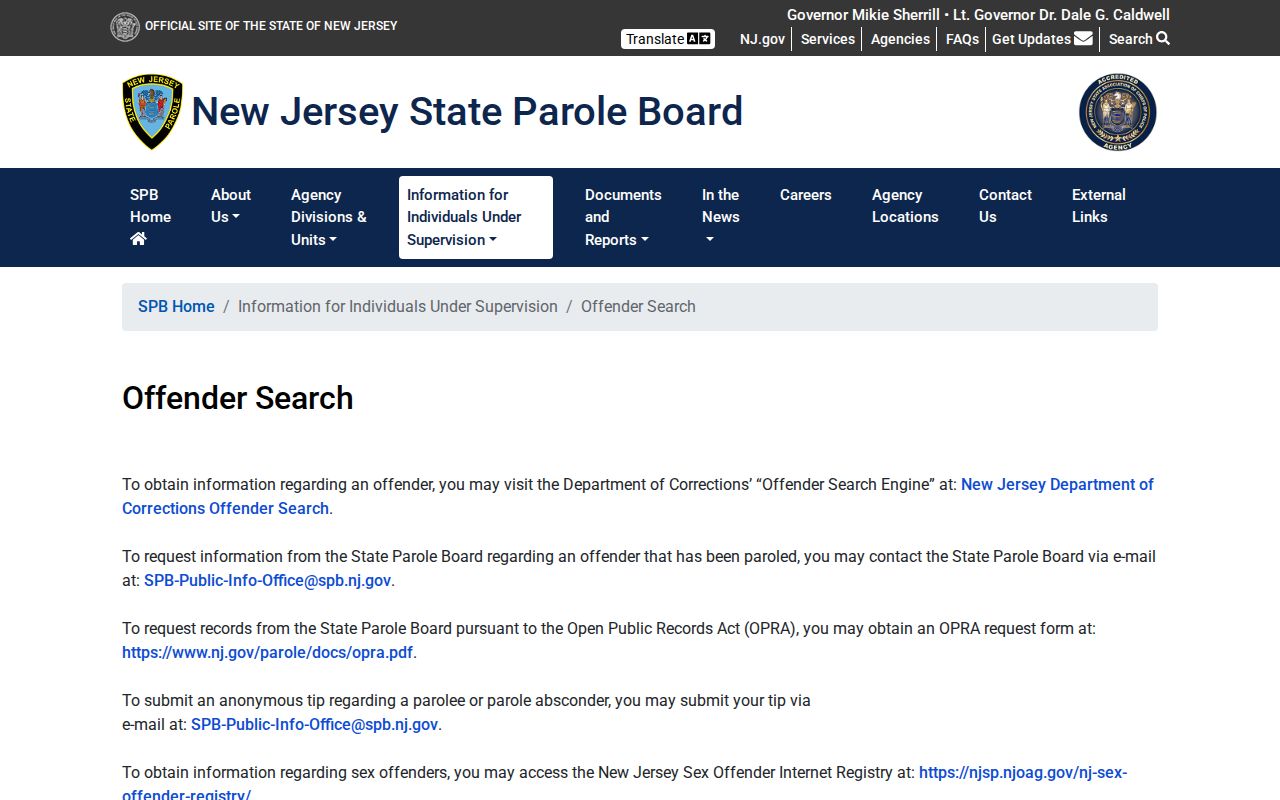
The capture reinforces the split between NJDOC’s public offender record and the Board’s person-level parole information route.
New Jersey State Parole BoardP.O. Box 862
Trenton, NJ 08625-0862
609-292-4257
SPB-Public-Info-Office@spb.nj.gov NJSPB District Office #3
1828 West Lake Avenue
Third Floor, Suite 300
Neptune, NJ 07753
The current locations page does not publish District Office #3’s coverage or a local telephone number. Older reports linked it to Monmouth and northern Ocean, but current person-level questions should go through the central Board rather than relying on an old local contact.
New Jersey Parole Record Scope
NJSPB is a release-decision and community-supervision agency, not a jail. A parolee has left prison. The person is in the community subject to Board authority and conditions unless another hold or placement applies. The Board’s record should not be described as a county-jail release roster.
A public NJDOC record may show the state incarceration and Date Out-of-Custody. The Board can address public parole information and identified decisions. Neither source provides unrestricted access to supervision notes or current residence. A no-result on a news or “most wanted” page cannot prove there is no parole warrant.
- Parole
- Release from prison while a person remains under Board supervision.
- Eligibility
- The point when release may be considered, not an entitlement to leave.
- Rescission
- Withdrawal of a parole grant before physical release under the Board’s process.
- Revocation
- Board action that can return a parolee to custody after a violation process.
- Absconder
- A person alleged to have left supervision without authorization.
Monmouth Parole Eligibility Notices
NJSPB publishes regularly refreshed parole eligibility notices organized by county. The current Monmouth notice can list a name and SBI number along with sentence date, judge, sentence, jail credit, location, offense, and indictment information. It bridges the Monmouth sentence to the person’s current state location even when MCCI’s online search is unavailable.
The notice is prospective. It identifies people who may be considered for parole and provides timing for public comment. It is not a final decisions database, a list of completed releases, or proof that supervision began. A hearing can grant or deny parole, set a future eligibility term, or lead to other review. Another detainer or rescission can also prevent physical release after an earlier favorable step.
Note: An eligibility notice supports identity and timing research but cannot replace a dated NJDOC release record or Board confirmation.
NJSPB Release Hearing Stages
The Board describes initial, panel, rescission, and revocation hearings. An initial or panel review addresses possible release. A rescission process can revisit a grant before the person leaves custody. A revocation process concerns alleged violations after parole has begun.
These stages explain why an eligibility date, hearing listing, and actual release date can differ. The public should preserve the name, SBI number, notice month, and official source date, then obtain the final outcome from the Board when it is releasable. Do not infer the decision from a calendar alone.
Monmouth Parole Warrant Checks
NJSPB’s Fugitive Apprehension Unit investigates parole absconders and returns them to custody. The official tipline is 1-800-668-7025, and the tip email is SPB-Fugitive-Tip-Submit@spb.nj.gov. Those contacts are for fugitive information, not a public statewide name search.
No current public statewide parole-absconder lookup was found. Absence from a most-wanted or news page proves nothing about an active warrant. Route person-level status questions through the Public Information Office and do not attempt to infer warrant status from an ordinary parole eligibility notice.
New Jersey Parole Discharge
Parole discharge ends the Board jurisdiction described by the discharge record. It should not be assumed from a long-past prison release date. Obtain the identified certificate or final record when the distinction matters. NJDOC Date Out-of-Custody establishes the prison endpoint, while NJSPB establishes its own supervision endpoint.
A focused OPRA request can ask for a named final decision or release certificate. The custodian may withhold protected parts while providing separable public material. Record the exact wording and agency. “Released,” “paroled,” and “discharged” describe different points in a sentence and should remain distinct.
Monmouth Parole Versus Probation
A Monmouth County person can be on probation without any NJDOC prison record. Probation belongs to the Judiciary and can follow a county-jail term or a noncustodial sentence. The public court judgment may show that probation was imposed. It may not prove that supervision remains active on the day checked, and Court Rule 1:38-3(d)(12) restricts probation records.
The statewide Probation Ombudsman supplies procedure and current contact information but cannot change a condition or act for the probationer. Monmouth Probation is listed at 2407 Route 66 in Ocean. There is no public statewide probationer name search. Officer notes, addresses, case plans, and compliance information should not be promised as public records.
Parole uses a different chain. NJDOC identifies the state incarceration and Date Out-of-Custody. NJSPB addresses the release decision and supervision. A court docket may contain the judgment, but a state-parole question does not become a probation question merely because both forms of supervision occur in the community.
Parole Release Interruptions
A favorable eligibility or hearing event may not lead to immediate physical release. The Board describes rescission proceedings that can revisit a grant before departure. A new sentence, mandatory term, institutional event, or another detainer can also affect timing. This is why an eligibility notice and release confirmation must remain separate.
After parole begins, an alleged violation can lead to revocation proceedings and return to custody. The public information route can address releasable status, while protected supervision details remain outside ordinary access. Save the exact date and status from NJDOC and NJSPB rather than compressing the sequence into one “released” label.
A VINE custody-change alert can help near prison release, but it is not a Board supervision record. Likewise, the public sex-offender registry serves a separate statutory purpose and covers only qualifying registrants. Neither channel proves parole compliance, discharge, or warrant status. NJSPB remains the responsible source for public state-parole information.
When a Monmouth judgment includes state imprisonment, keep the court case with the NJDOC and Board records. The judgment explains the sentence. NJDOC marks the prison interval. NJSPB documents parole action and its own supervision endpoint. This three-source chain prevents an eligibility notice from being mistaken for a completed release.
Note: Board eligibility, a parole grant, physical prison release, and final supervision discharge can occur at four different points.