
Monmouth Parole and Probation Compared
A person may be back in the Monmouth County community and still owe duties under a sentence. Parole means release from state prison before the sentence and supervision have fully ended. The New Jersey State Parole Board, or NJSPB, controls that status. Probation is a sentence or part of a sentence supervised through New Jersey Courts. It can follow time at the Monmouth County Correctional Institution, or MCCI, but it does not require an NJDOC prison commitment.
That split determines where a valid check begins. A Monmouth County parole inquiry starts with the NJDOC offender record and continues with NJSPB. A probation inquiry starts with the judgment or case disposition and continues through the Judiciary. Neither agency publishes a statewide public name list that reveals an assigned officer, home address, reporting schedule, case plan, or day-to-day compliance.
| Point | Parole | Probation |
|---|---|---|
| Who imposes it | NJSPB release process after a state prison term | A court judgment or later court order |
| Supervising system | New Jersey State Parole Board | New Jersey Courts Probation Division |
| Public starting record | NJDOC offender history and Date Out-of-Custody | Criminal judgment, disposition, and later docket orders |
| What release means | Out of prison, but still under parole jurisdiction | In the community under court-ordered terms |
| How it ends | Discharge or other final Board action | Completion or a court order ending probation |
- Parole
- Supervised release from state prison before the full sentence process is complete.
- Probation
- Court-ordered community supervision that may exist with or without a prison term.
- Discharge
- The formal end of the applicable custody or supervision status.
- Absconder
- A person alleged to have left parole supervision without authorization.
Verify Monmouth Post-Release Supervision
Start with the record that created the supervision. For parole, use the NJDOC incarcerated-person finder. Match the SBI number, county of commitment, sentence, physical details, and incarceration history. A Date Out-of-Custody confirms an NJDOC exit, but does not by itself distinguish parole from full discharge. The Board’s public-information office supplies the next authorized check.
Probation requires a different chain. Review the public criminal case or judgment for a probation term, then look for later orders that modify, revoke, or end it. Court Rule 1:38-3(d)(12) restricts probation records, so a docket may show that probation was imposed without exposing present officer notes or supervision details.
- Identify whether the person left MCCI, an NJDOC prison, or another system. Do not treat a county-jail departure as proof of parole.
- For parole, match the NJDOC record and read Date Out-of-Custody, sentence history, and any displayed release status.
- Ask the NJSPB Public Information Office for releasable information about the matched person.
- For probation, obtain the Monmouth criminal judgment or disposition and review later court orders.
- Use the Judiciary’s probation contacts for process help, recognizing that restricted material may not be disclosed.
- Preserve the source date and identifier because common names and later orders can change the result.
Note: A parole eligibility notice is prospective and does not prove that parole was granted or that physical release occurred.
Monmouth Supervision Office Routes
The current NJSPB locations page lists District Office #3 in Neptune. Older reports linked that district with Monmouth and northern Ocean counties, but the current page does not state its coverage or publish a local phone number. Current person-level questions should go through the Board’s central number or public-information email. This avoids relying on an old district assignment.
New Jersey State Parole Board
District Office #3
1828 West Lake Avenue, Third Floor, Suite 300
Neptune, NJ 07753
Central telephone: 609-292-4257
Public information: SPB-Public-Info-Office@spb.nj.gov
Official NJSPB locations
Monmouth Probation is listed by the Judiciary at 2407 Route 66, Ocean, NJ 07712. The statewide Probation Ombudsman can explain procedure and current contact paths at 609-815-3810 ext. 16357 or ProbationHelp.Mailbox@njcourts.gov. The ombudsman cannot alter conditions, give legal advice, or act for the probationer.
Monmouth Parole Hearing Records
The Board’s parole eligibility notices are the nearest public schedule. Weekly reports were visible during the research period. A Monmouth entry may show a name, SBI number, jail credit, sentence date, judge, current location, offense, and indictment details. The notice states a consideration month, comment deadline, and a later period through which release may occur if approved.
It is not a decisions database. The normal process can move from a hearing officer to a two-member panel. A panel may grant parole or deny it and set a Future Eligibility Term, which is the next period before another review. New adverse information can lead to rescission proceedings before release. After release, alleged serious or repeated violations can lead to preliminary and revocation hearings. No official public person-level results search was found, so a listed name should never be described as a granted parole or completed Monmouth County release.
The NJSPB hearing explanation shows each stage and possible outcome. An identifiable final record may also be sought with the Board’s OPRA form, subject to protected victim, medical, security, and supervision material.
The NJSPB offender-search information page directs public inquiries to NJDOC and the Board’s public-information route.
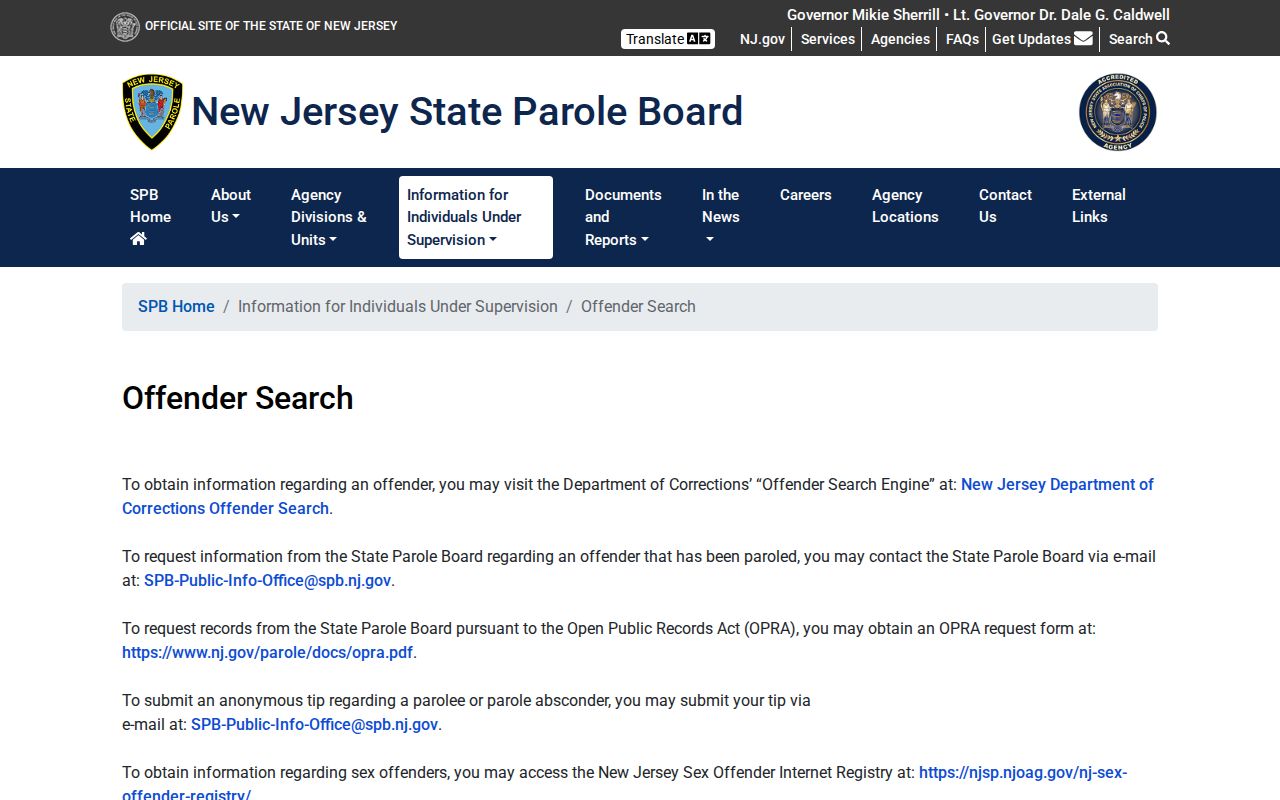
The captured state page confirms the proper agency handoff. It does not expose a public parolee roster or person-level decision results.
Monmouth Parole Violations and Warrants
Supervision can carry reporting, travel, treatment, and other person-specific conditions. Those terms come from the controlling order or release certificate, not a general public page. A violation allegation is also distinct from a final finding. Serious or persistent parole allegations may lead to a revocation process, while a probation issue returns to the court system.
NJSPB’s Fugitive Apprehension Unit investigates parole absconders and returns them to custody. An absconder is someone alleged to have left supervision without permission. The official tipline is 1-800-668-7025, and the tip email is SPB-Fugitive-Tip-Submit@spb.nj.gov. No public statewide absconder name search was found. A missing name on a news or wanted page does not prove that no warrant exists.
Note: A transfer back into custody is not the same event as final discharge from a Monmouth County sentence.
Monmouth Reentry and Recovery Resources
MCCI’s Substance Abuse Services information documents a local post-release path. When MCCI Social Services makes a referral, the unit can help arrange interviews with inpatient treatment providers and connect a person with recovery resources. That support can begin around the custody transition, but program participation is not evidence of a release date or supervision status.
The Sheriff’s Monmouth County HOPE program also identifies the HOPE One mobile unit and community partners. It functions as a route to services. It does not search NJDOC, confirm an MCCI release, or identify a parole officer. Keep those roles separate when helping someone reconnect after a Monmouth County release.
Monmouth Release Property Records
New Jersey’s county-jail retention schedule gives a former MCCI inmate a concrete records path. Daily Working Files may include a personal-property receipt and an information correction sheet. The schedule retains that series for three years after release. A prompt, focused request can therefore seek an existing receipt or correction form tied to a named confinement.
Retention does not guarantee public access or create a correction procedure. Security, medical, victim, juvenile, expunged, and other protected information may be withheld or redacted. Ask MCSO for the exact existing document and a written legal basis for any denial. The full county release search and OPRA path appears on the Monmouth County released inmates home page.
Note: Property paperwork can document a release transaction, but it does not prove that parole or probation has ended.
Ending Monmouth Post-Release Supervision
Leaving a facility and ending legal supervision are separate events. NJDOC’s Date Out-of-Custody marks an exit from state custody in the offender history. A parole discharge requires the applicable Board action. Probation ends under the judgment, later court orders, or other lawful completion shown through the Judiciary record. A person can also finish prison custody while a mandatory period of supervision continues.
For a durable parole record, identify the person by SBI number and ask NJSPB for an identifiable final action or release certificate. For probation, request the judgment and any later order that ends or changes the term. Public access remains limited by Court Rule 1:38-3(d)(12) and other confidentiality rules. Verification should state only what the dated source establishes.
Eligibility statutes also affect the sequence. N.J.S.A. 30:4-123.51 generally places primary parole eligibility after a mandatory minimum, or after one-third of the sentence less allowable credits when no minimum applies. Administrative parole under N.J.S.A. 30:4-123.55b et seq. has stated exclusions and conduct or program requirements. Neither framework turns an eligibility date into a final release or discharge record.
When the public record is unclear, ask for a narrow existing document rather than a broad explanation. The NJSPB OPRA form can be used for an identifiable final decision or release certificate, subject to confidentiality. For probation, the court docket and judgment remain the public record path. Exact officer notes, victim information, medical material, and security details may remain protected.
A final verification should name the source and date. It should also distinguish prison release, parole supervision, probation, and full discharge. That wording preserves the difference between living in the community and being free of every remaining sentence term.